
En Volá has launched three online cannabis courses after 13 years of education work. Here is what the Chilean project means for Valencia readers.

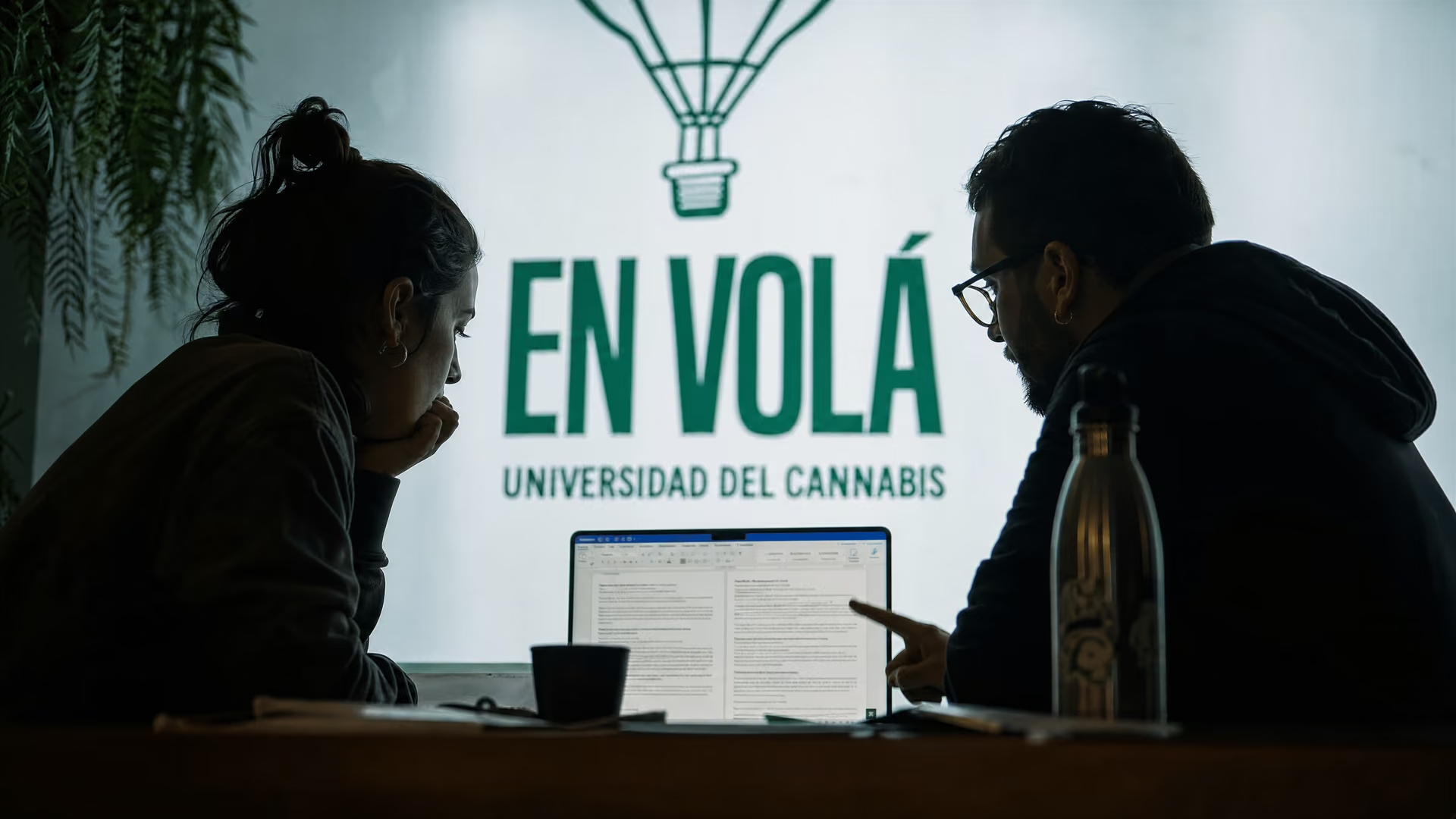
En Volá has launched three online cannabis courses after more than 13 years of science communication, activism and community education, according to El Planteo’s report on Universidad En Volá. The Chilean platform’s first programmes cover cultivation at home, cannabis science and cooking, and training for people who want to work as budtenders.
En Volá turns 13 years of work into three online courses
Universidad En Volá is presented as a new educational platform built from knowledge that the organisation has accumulated over more than a decade. Its launch brings together three subjects that the platform says have generated sustained interest among its community, while moving beyond the short-form videos, posts and individual explanations that have traditionally carried much of its public work.
Simón Espinosa, En Volá’s executive director and founding partner, told El Planteo that the project is intended to organise that experience into a professional and community-oriented learning route. Espinosa is also identified as a journalist and writer. His description places the emphasis on systematising existing work rather than starting a separate project without a history behind it.
The launch can be reduced to four grounded markers:
The idea had existed for roughly six years before it reached the public. Espinosa said it was first considered with Nicolás Leyton, who was then an editor at the media outlet, but was postponed because of competing priorities and limited resources. The underlying intention, however, remained in place.
That history explains why the launch is framed by Espinosa as a continuation of En Volá’s work rather than a sudden change of direction. The platform is taking material shaped by research, public questions and years of communication and giving it a defined sequence.

The three subject areas at the centre of the launch
The initial offer is deliberately limited to three areas. The source describes them as cultivation at home, science and cooking related to cannabis, and training for work as a budtender. They are not presented as a broad catalogue, but as a first selection based on questions and interests repeatedly raised by En Volá’s audience.
The three subject areas described in the launch report are:
| Programme area | Subject | How the report positions it | Source |
|---|---|---|---|
| Cultivation at home | Home cultivation | One of the areas most frequently requested by the community | El Planteo report |
| Science and cooking | Cannabis science and cooking | Combines scientific explanation with culinary subject matter | El Planteo report |
| Budtender training | Training for work as a budtender | Addresses preparation for a role in the emerging industry | El Planteo report |
All three programmes are online and can be completed at the learner’s own pace, according to the report. That format is significant to the project’s design: the university is not described as a single live event or a collection of disconnected talks, but as a course-based platform intended to guide participants through a subject from beginning to end.
The budtender programme also gives the launch a clear professional dimension. Espinosa’s stated aim is not simply to distribute more information, but to help form people who can contribute to their communities and to a sector that En Volá wants to see become more professional. The report does not claim that completing a course creates a regulated professional qualification.
The same caution applies to the course on cultivation and the programme covering science and cooking. The report identifies their subject areas, but does not provide a formal accreditation framework, an institutional partnership or a government-recognised qualification. What it does describe is a structured educational product developed by En Volá.
Why En Volá says information alone is not education
Espinosa’s central argument is that the internet already contains an enormous amount of cannabis-related material. Definitions, historical accounts, tutorials, scientific studies, personal testimony, forum discussions and social-media posts are all readily available. The problem, in his account, is how a learner navigates that abundance.
“Education goes far beyond collecting information,” Espinosa said in the El Planteo interview about the platform’s educational approach. He also warned that an excess of information can leave people disoriented. Universidad En Volá’s answer is to gather the organisation’s experience and place it in a format that is intended to be simple to follow.
The difference between the courses and En Volá’s continuing free content can be summarised in four parts:
- A video or social-media post generally addresses one question at a time, while a course is designed to provide a beginning-to-end route.
- The programmes are arranged as a learning sequence rather than as an archive that the audience must navigate independently.
- The course format is intended to avoid dependence on algorithms, viewing figures or commercial integrations.
- The scientific material is presented alongside the tone of humour and care that Espinosa associates with En Volá’s public identity.
That distinction also reflects the economic reality described in the report. Cannabis-focused media and creators can face difficulty monetising their work on platforms such as YouTube. The university therefore becomes a separate format for delivering organised instruction, without turning every lesson into a performance shaped by platform incentives.
These courses are designed to guide people from beginning to end, without show, interventions or another incentive.
Simón Espinosa, quoted by El Planteo and translated from Spanish
The intended tone is not presented as a rejection of scientific rigour. Espinosa says the courses were made with “a lot of science and also a lot of care”, and argues that a good teacher should inspire people to find their place within a subject. In that formulation, accessibility is part of the teaching method, not a substitute for evidence.
The course design can be pictured as a move from scattered material to a defined route:

A six-year idea shaped by questions from the community
Universidad En Volá was not developed in isolation. The project grew from years of contact with the people who followed the organisation’s work, including questions posted in comments, emails and surveys, as well as conversations at events, workshops and conferences. Espinosa described those interactions as part of the process that determined what the platform became.
That detail matters because the three courses were not selected solely as abstract subjects. They reflect areas that En Volá says its audience has repeatedly asked about. The launch therefore combines editorial judgment with a form of community feedback, even though the report does not provide enrolment figures or a breakdown of the questions that influenced each programme.
Espinosa’s account also presents the project as unfinished in a deliberate sense. He said that knowledge changes and that new courses would eventually be needed to update what the platform teaches. The educational model is therefore described as something capable of developing over time, rather than a fixed library that will never be revised.
It is never too late for education.
Simón Espinosa, quoted by El Planteo and translated from Spanish
The phrase captures both the delayed launch and the organisation’s view of learning. The university idea waited because of priorities and resources, but the delay did not erase it. En Volá has now used the project to turn a long period of public communication into a more formal educational structure.
Education, community and professionalisation in En Volá’s stated aims
Espinosa described several objectives for the university. They extend beyond the delivery of lessons and place the courses within En Volá’s broader understanding of the cannabis sector and its communities. These are the organisation’s stated goals, not an assessment of outcomes, since the launch report does not yet provide data on completion, employment or wider impact.
- Disseminate scientific knowledge about cannabis.
- Educate with humour and care.
- Strengthen the community connected to En Volá’s work.
- Contribute to movement towards regulation.
- Support the professionalisation of the industry.
- Help develop people who can act as agents of change and bring cohesion to their communities.
The wording is important. En Volá is not describing the university as a government education service or as a replacement for a public institution. It is presenting a community-built online platform that draws on the experience of its own team and on a stated commitment to science communication.
That distinction is especially relevant when the word “professionalisation” is used. In the report, it describes an aspiration to improve knowledge and preparation within the sector. It should not be read as evidence that the courses themselves create a legally protected occupation or certify a person to perform regulated duties.
What the launch does and does not mean for Valencia readers
The story concerns En Volá, a Chilean cannabis education platform, and not a Valencian association, the Generalitat Valenciana, the city council or the Spanish Parliament. Nothing in the supplied report describes a Spanish legal reform, a decision by Spain’s courts or an amendment to the Spanish Penal Code.
For readers in Valencia and the wider province, the local distinction is straightforward. Cannabis social clubs in Spain are private, members-only, non-profit associations. They are not shops, dispensaries or venues open to the public or to tourists. Membership is a private matter decided by each association, and an online educational project in another jurisdiction does not grant access to any Valencian club.
The launch is therefore best understood as an education and media development, not as an announcement about club access in Valencia. Its relevance to local readers lies in the way it shows one cannabis-sector organisation trying to organise public-facing knowledge, respond to recurring community questions and connect education with its own stated goal of professionalisation.
That approach may be familiar to readers who follow the social-club ecosystem, where legal status and public messaging also need to be kept separate. A course about cannabis does not itself determine the rules governing private associations in Spain, just as a private association does not become a public educational institution merely by sharing information.
The practical takeaway from Universidad En Volá’s launch
Universidad En Volá begins with a narrow, defined offer: three online courses based on more than 13 years of communication, research and community engagement. The project’s distinguishing claim is not that information is unavailable, but that learners need help separating, ordering and understanding it. For Valencia readers, the announcement is a report on an overseas education initiative rather than a change to Spain’s private social-club framework.
Universidad En Volá’s launch turns a long-running body of public education into three defined online courses. Its immediate significance is organisational: it offers a structured learning route while leaving Spain’s legal framework and Valencia’s private social-club model unchanged.
Sources
- Reducir daños del basuco exige enfrentar también la violencia (canamo.net)
- Irlanda busca destrabar el cáñamo industrial tras cultivar solo 11 hectáreas (canamo.net)
- ‘Nunca Es Tarde Para la Educación’: En Volá Lanza 3 Cursos Online Sobre Cannabis (elplanteo.com)
- Cómo EEUU Mató la Bonanza Marimbera Colombiana y Creó los Cárteles de Cocaína (elplanteo.com)
- PP y Vox vuelven a bajar impuestos a los ricos valencianos: perdonan más de 62 millones en Patrimonio a 8 de cada 10 (eldiario.es)
- Cuentas sin alma: la trampa ideológica en los presupuestos de la Generalitat (eldiario.es)
- ¿Qué tiempo hará el domingo 2 de agosto en la Comunitat Valenciana? (lasprovincias.es)
- Declarados tres incendios en zonas afectadas por tormentas eléctricas en el interior de Valencia (lasprovincias.es)
- José Mª García (SETT): "Valencia tiene oportunidades para ser un gran 'hub' europeo de fotónica" (valenciaplaza.com)
- La Generalitat desplegará un plan para eliminar datos duplicados y preparar sus bases para la IA (valenciaplaza.com)